 Buckwheat
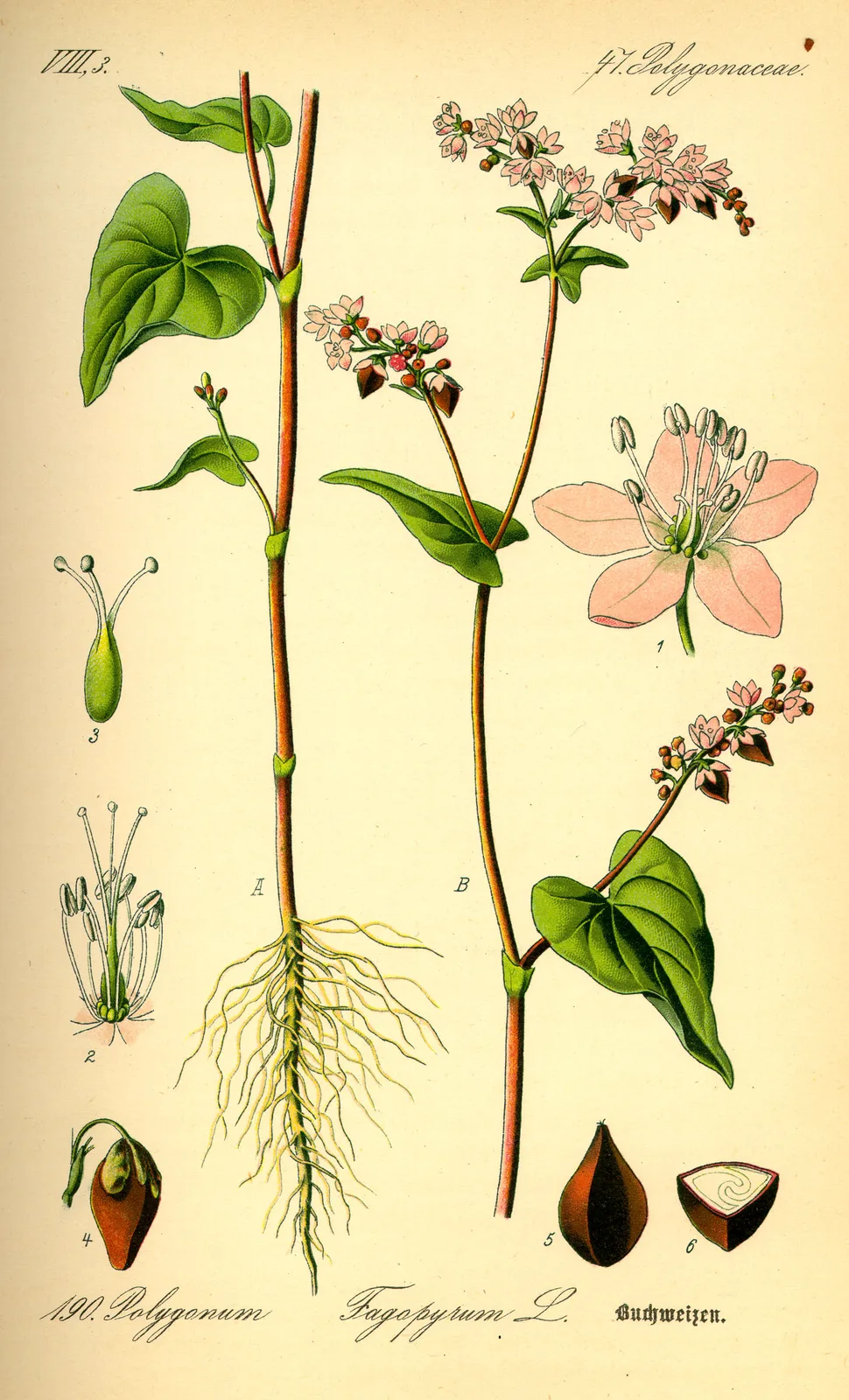
Buckwheat is a flowering plant whose scientific name is Fagopyrum esculentum, belonging to the knotweed family Polygonaceae. Despite its name, buckwheat is not a cereal or a grass, and is instead related to sorrel, knotweed, and rhubarb. It is classed as a pseudocereal because its seeds have a high starch content that allows them to be cooked like a cereal. Buckwheat cultivation began around the 6th millennium BC in what is now Yunnan Province in southwestern China. It later spread from Central Asia and Tibet to the Middle East and Europe, reaching Europe by the 15th century.
Usage in beverages
Buckwheat can be used to make a malt and brew a gluten-free beer that lacks gliadin and hordein, making it suitable for people sensitive to gluten. It also forms the basis of buckwheat tea, in which the buckwheat is husked, cooked, and dried, then pan-fried without oil; Tartary buckwheat is commonly roasted to make this tea. To prepare buckwheat tea, roasted buckwheat is added to water at 90 degrees Celsius and infused for two to four minutes. In Korea, buckwheat tea is called memil-cha and can be drunk either warm or cold, sometimes served in place of water, and Tartary buckwheat grown in Gangwon Province has recently become popular for making memil-cha because it is nuttier and higher in rutin. Buckwheat shōchū is a Japanese distilled drink that has been produced since the 16th century, and it has a milder taste than barley shōchū; Tartary buckwheat can likewise be distilled to make alcohol. In Edo-period Japan, soba establishments often also served sake and functioned much like modern cafes for casual meals, and after eating soba noodles, many Japanese people drink the water in which the noodles were cooked, called sobayu, mixed with the leftover dipping sauce. The Ethiopian mead variant tej is flavored with the powdered leaves and bark of gesho, a hop-like bittering agent from a species of buckthorn. Traditional kvass is made from a mash of rye bread or rye flour and malt soaked in hot water, then fermented for about 12 hours with sugar and yeast.
In depth
Botanical identity
Buckwheat is a flowering plant whose scientific name is Fagopyrum esculentum, belonging to the knotweed family Polygonaceae. Despite its name, buckwheat is not a cereal or a grass, and is instead related to sorrel, knotweed, and rhubarb. Buckwheat is classed as a pseudocereal because its seeds have a high starch content that allows them to be cooked like a cereal. Buckwheat cultivation began around the 6th millennium BC in what is now Yunnan Province in southwestern China. Buckwheat spread from Central Asia and Tibet to the Middle East and Europe, reaching Europe by the 15th century. Salicylaldehyde has been identified as a characteristic component of buckwheat aroma. Nectar from flowering buckwheat yields a dark-colored honey. Buckwheat can be used to make a malt and brew a gluten-free beer that lacks gliadin and hordein, making it suitable for people sensitive to gluten. Buckwheat shōchū is a Japanese distilled drink that has been produced since the 16th century. Buckwheat shōchū has a milder taste than barley shōchū.[1]
In Korea
In Korea, buckwheat tea is called memil-cha and can be drunk either warm or cold, sometimes served in place of water. Tartary buckwheat grown in Gangwon Province has recently become popular for making memil-cha because it is nuttier and higher in rutin. To make buckwheat tea, roasted buckwheat is added to water at 90 degrees Celsius and infused for two to four minutes. In preparing buckwheat tea, the buckwheat is husked, cooked, and dried, then pan-fried without oil.[2]
In Japan
In Edo-period Japan, soba establishments often also served sake and functioned much like modern cafes for casual meals. After eating soba noodles, many Japanese people drink the water in which the noodles were cooked, called sobayu, mixed with the leftover dipping sauce.[3]
In China
Tartary buckwheat can be distilled to make alcohol. Tartary buckwheat is commonly roasted to make buckwheat tea.[4]
In Ethiopia
The Ethiopian mead variant tej is flavored with the powdered leaves and bark of gesho, a hop-like bittering agent from a species of buckthorn.[5]
In Russia
Traditional kvass is made from a mash of rye bread or rye flour and malt soaked in hot water, then fermented for about 12 hours with sugar and yeast.[6]