 Lovage
A tall perennial herb of the carrot family whose leaves, roots, and seeds carry an intense, savory celery-and-anise character. In beverages it appears as an infusion, a flavoring in spirits and aromatized wines, and as the basis of traditional cordials.
How lovage is prepared
Lovage is infused as an herbal tea, distilled or macerated into herb-forward spirits such as akvavit and gin in the company of other Apiaceae botanicals like caraway, dill, and fennel, and is the defining note of a traditional brandy-based cordial associated with Cornwall. As a savory aromatic it also belongs to the family of botanicals used in aromatized wines and bitters.

A short mixed-culture fermentation in which reusable water-kefir grains turn a sweet water, fruit, or botanical infusion into a lightly sour, gently sparkling base. For no- and low-ABV beverage work, its value is structure: acidity, dissolved CO2, residual sweetness, and soft lactic roundness can make a blend feel integrated without relying on alcohol.
MURI uses Lovage Water Kefir in MURI × ESSE: The Middle: a water kefir scented with lovage, used as a savory herbal component in a blend.[7]
Service signal Vibrant savory-green lovage with gentle lactic creaminess.
In depth
Origins and early European cultivation
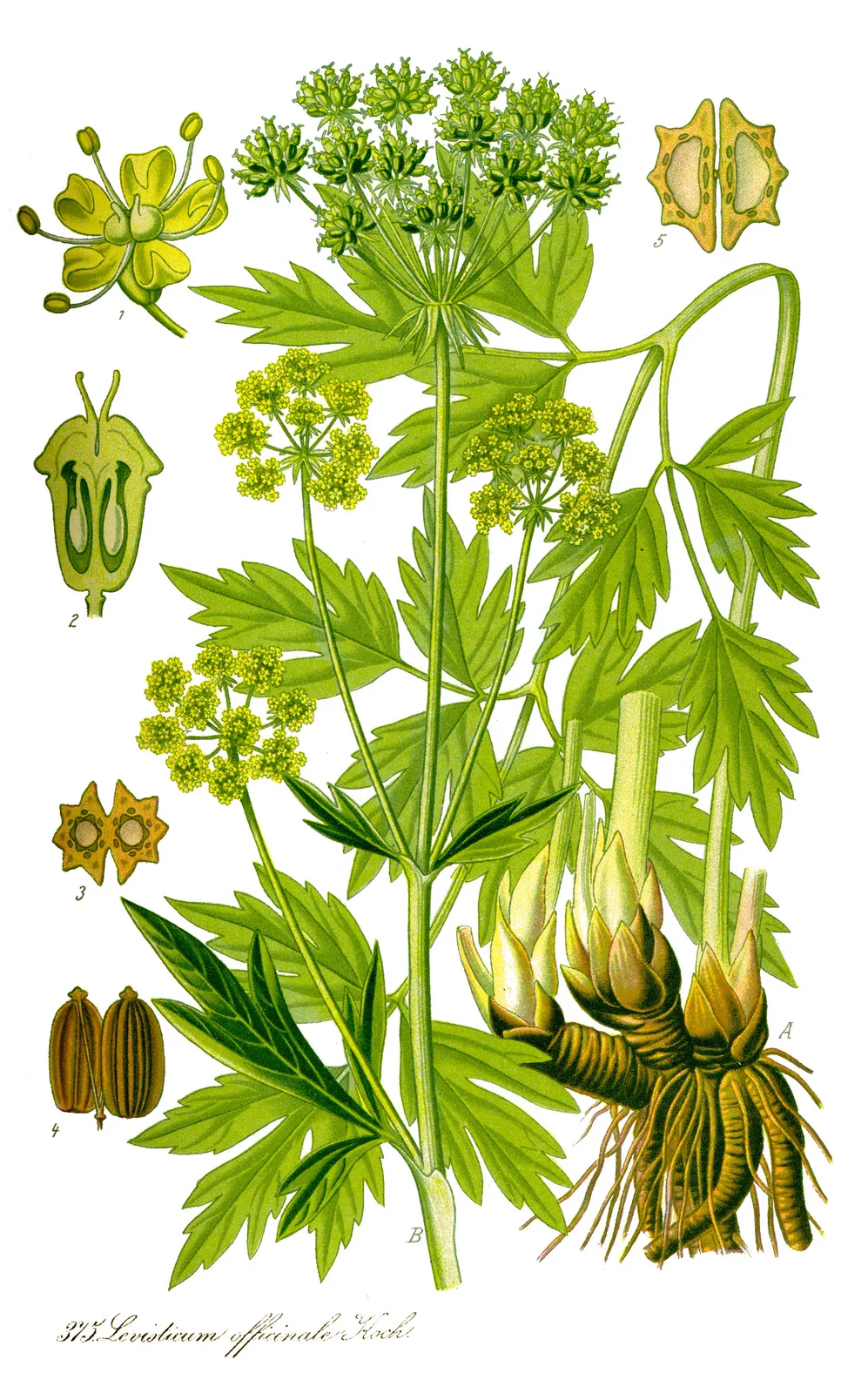
Lovage (Levisticum officinale) is a tall perennial of the carrot family, native to the region of present-day Afghanistan and Iran but long naturalized in European gardens. Whether eaten or steeped, its leaves and seeds give off a smell and taste that recall celery and parsley but stronger and spicier, with the seed standing in for fennel. The plant's deep roots in European horticulture are signaled by its appearance among the herbs recommended for cultivation on royal estates in Charlemagne's early-ninth-century estate guidance, and by its medieval English name, a folk reshaping of older forms that ultimately point back to Liguria in northwest Italy, where the herb was widely grown. From these gardens lovage passed easily into the world of home remedies and homemade drinks, since the same intensely aromatic parts prized in the kitchen also lent themselves to steeping.[1]
The herbal infusion tradition
As a herb that can be steeped in hot water, lovage belongs to the broad family of herbal infusions—non-tea beverages, sometimes called tisanes, made by pouring hot or boiling water over plant material. Such infusions can be drawn from leaves, seeds, or roots, the very parts of lovage used in cooking, and lovage's seeds in particular lend themselves to steeping much as caraway, dill, anise, and fennel seeds do. These herbal drinks have long sat at the boundary between refreshment and folk medicine, and lovage fits the pattern: its root has been used as a mild diuretic, and across cultures the plant has carried a reputation for aiding digestion. In Ukraine an infusion of lovage leaves was traditionally used by women as a fragrant hair rinse, a reminder that the herb's strong, pleasant aroma made it as valued in steeped preparations as in the pot.[2]
The Cornish lovage cordial and brandy tradition
The clearest historical link between lovage and a named drink lies in southwest England, where an alcoholic lovage cordial was traditionally stirred into brandy as a warming winter beverage. The custom is particularly associated with Cornwall, where, according to local lore, the cordial was first used to mask the salty taste of smuggled brandy that had been spoiled in transit, the herb's bold celery-anise character covering the off-flavor. The practice survives as a regional speciality, with the sweet, aromatic lovage cordial serving both as a flavoring and as the foundation for a comforting cold-weather mixed drink. It is a vivid example of how a strongly scented kitchen herb could be turned into the signature of a localized drinking habit.[1]
Lovage, the savory aroma, and the "Maggi herb" association
In German-, Dutch-, and Danish-speaking regions lovage is widely known as the "Maggi herb" (Maggikraut, maggikruid, maggiurt) because its aroma strongly resembles that of a popular dark, hydrolyzed-vegetable-protein seasoning sauce—even though the herb is not actually an ingredient in the sauce. The resemblance comes from shared aroma chemistry: lovage owes its scent largely to the compound sotolon, while the savory sauce contains a closely related molecule sometimes nicknamed "Maggi lactone." This deep association with a brothy, umami-rich flavor explains why lovage reads as distinctly savory rather than sweet, a quality that shapes how it behaves in any beverage and aligns it with the herb-and-seed botanicals used to build complex, savory drink profiles.[3]
A botanical for akvavit and Scandinavian herb spirits
Lovage sits naturally within the botanical vocabulary of akvavit, the flavored Scandinavian spirit distilled from grain or potatoes and produced in the region since the fifteenth century. Akvavit takes its character from caraway and dill, with supporting botanicals that commonly include cardamom, cumin, anise, coriander, and fennel—an aromatic palette closely related to lovage's own celery-and-anise tones. Because each producer's recipe differs in its choice of supporting herbs and seeds, savory Apiaceae botanicals of lovage's type fit the tradition of a clear or cask-aged caraway-led spirit drunk chilled at festive Nordic gatherings such as Christmas and Midsummer, often alongside pickled herring and other rich foods that the herbs are said to help digest.[4]
Aromatized wines and bitters
The same savory-herbal quality places lovage within the wider world of botanical drinks built on roots, barks, seeds, and herbs. Aromatized fortified wines such as vermouth are flavored with proprietary blends of aromatic botanicals—coriander, cardamom, citrus peel, marjoram, chamomile, and many others—chosen to balance bitterness and sweetness in an apéritif. Bitters, likewise, are alcoholic (and increasingly glycerin-based, alcohol-free) preparations flavored with herbs, roots, and peels to add depth and a fifth dimension of flavor to mixed drinks. Lovage's pungent, root-and-seed character belongs comfortably to this savory-aromatic register, and it appears among the herbs that lend complexity to such infused and aromatized beverages.[5]
Lovage in the modern gin and craft revival
Gin offers a natural home for lovage in the contemporary drinks scene. A juniper-led spirit flavored with a wide range of botanicals, gin has, since around 2013, entered a period of vigorous worldwide experimentation, with new producers reaching beyond the classic core of coriander, citrus peel, and angelica, orris, and licorice roots toward more unusual flavorings to distinguish their products. Lovage's leaves, seeds, and roots—savory, celery-like, and faintly anise—make it an appealing botanical for distillers seeking a green, vegetal, herbaceous note, echoing gin's long use of root and seed botanicals to fix and combine aromas. In the same spirit of revival that has lifted akvavit, vermouth, and bitters, lovage now turns up in craft infusions, savory cordials, and herb-forward low- and no-alcohol drinks that prize its distinctive, broth-like depth.[6]