 Rice
Rice
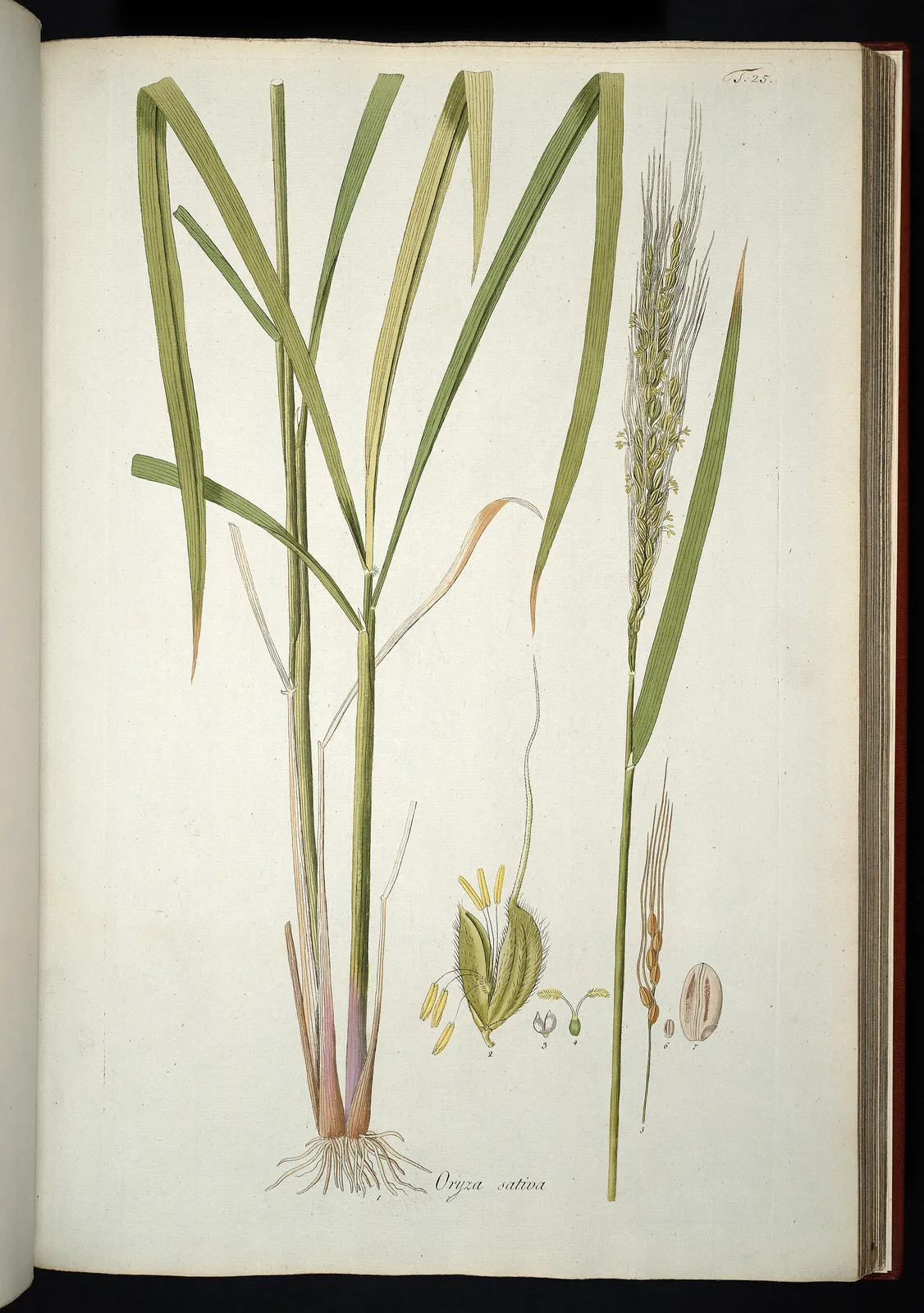
A cereal grain, the edible seed of the grass Oryza sativa (and the African Oryza glaberrima), and one of the most widely cultivated staple foods. As a fermentation feedstock its high, clean starch content makes it a versatile base for sweetened, soured, and alcoholic ferments across many culinary traditions.
How rice is prepared
A fermentable starch base: saccharified to fermentable sugars, then fermented into a range of low- and non-alcoholic styles. Polished, whole-grain, and pigmented varieties give different color and flavor.

Cultivating koji mould, such as Aspergillus oryzae, on rice or other grains to produce enzymes that release sugars from starch and break down proteins. These enzymes support preparations ranging from sweet rice-koji amazake to fermented beverage bases.
Called amazake by MURI. The described preparation includes koji on steamed rice followed by fermentation of the liquid with cultivated yeast.[12]
Service signal Creamy, gently sweet, sake-like.
Koji rice amazake is confirmed. The yeast and lacto accounts for further fermentation remain unreconciled.[13]
Service signal Works as a liquid component.
The source names koji amazake. The extra yeast-fermentation stage described for the Koji Rice Series is not transferred to this preparation.[14]
Service signal Works as a liquid component.

Cooking an ingredient using steam.
Called amazake by MURI. The described preparation includes koji on steamed rice followed by fermentation of the liquid with cultivated yeast.[12]
Service signal Creamy, gently sweet, sake-like.
Koji rice amazake is confirmed. The yeast and lacto accounts for further fermentation remain unreconciled.[13]
Service signal Works as a liquid component.

Fermentation carried out by yeast. The organism, conditions and resulting alcohol level depend on the preparation.
Called amazake by MURI. The described preparation includes koji on steamed rice followed by fermentation of the liquid with cultivated yeast.[12]
Service signal Creamy, gently sweet, sake-like.
In depth
A grain built for fermentation
Rice is the edible seed of two domesticated grasses: Asian rice (Oryza sativa), grown worldwide today, and African rice (Oryza glaberrima), long important in West Africa. The archaeological and genetic record places the domestication of Asian rice in the Yangtze River basin of China, maturing over thousands of years; African rice was domesticated independently around the inland delta of the upper Niger River, in present-day Mali, from a different wild ancestor. Scholars still debate exactly how many times and when this happened, but the two-continent story is firm. What matters for the glass is the grain's chemistry: rice is almost pure starch, with very little free sugar, and brewing yeast can ferment simple sugars but cannot touch starch directly. Every rice beverage therefore begins by solving one problem: turning that starch into sugar.[1][2][3]
The saccharification problem
Cultures solved that problem in three broad ways. The oldest was the human mouth: chewing cooked rice mixes it with salivary amylase, an enzyme that frees sugars, and the sweetened mash then ferments with wild yeast. Japan remembers this as kuchikamizake, or mouth-chewed sake. A second path, dominant in Western brewing, is malting, where sprouting cereal grains make their own starch-splitting enzymes. The path that shaped most of Asia's rice drinks is the cultivated mold starter: filamentous fungi grown on steamed grain secrete amylases that convert starch to sugar, and they arrive bundled with the yeasts and bacteria that drive fermentation and flavor. That same enzymatic trick recurs under many names across the continent.[4][5]
China: the oldest rice ferments
China holds the earliest evidence. Residue on pottery from the Shangshan site in the Lower Yangtze, roughly nine to ten thousand years old, carries rice, mold (including Monascus) and yeast together, the signature of a starter-based rice brew and the oldest such evidence known in East Asia. Later sites such as Jiahu show mixed ferments of rice, honey and fruit. From these roots grew the Chinese family of grain wines made with qu (also written jiuqu), starter cakes colonized by Aspergillus, Rhizopus and Monascus molds. Qu underpins mijiu, everyday rice wine, and huangjiu, the amber yellow wine that served as a national drink through much of premodern China and was clearly described by the Han dynasty. The precise birthplace and date of qu are still debated, but mold-based saccharification in China is demonstrably ancient.[5][6][7]
Japan: sake and the koji lineage
Japan refined the mold path into a single domesticated fungus. Sake, or nihonshu, is brewed from polished rice, water, yeast and koji, which is steamed rice grown with Aspergillus oryzae. Its defining feature is multiple parallel fermentation: koji enzymes release sugar at the same time that yeast turns sugar into alcohol, in one tank, which lets sake reach unusually high strengths near twenty percent before dilution. The earliest written hint of drinking in Japan comes from a third-century Chinese chronicle; by 689 the imperial court kept a sake-brewing office, brewing with koji was recorded in 715, and a tenth-century legal code, the Engishiki, set down detailed methods. Earlier mouth-chewed brews gave way to koji over these centuries. Aspergillus oryzae is honored today as Japan's national fungus.[4][1]
Korea: the wild starter
Korea's rice brewing turns on nuruk, a starter cake left to catch wild molds, yeasts and bacteria rather than a single cultivated mold. That mixed, spontaneous character gives Korean drinks an earthier, funkier profile than the cleaner action of koji. Nuruk ferments makgeolli, a cloudy, milky brew of low to moderate strength, and cheongju, its clear and refined counterpart. Nuruk brewing reaches back at least to the Three Kingdoms era; a twelfth-century Chinese account already noted that Korean rice wines made with nuruk were stronger and deeper in color than the Chinese drinks of the day.[8][9]
South and Southeast Asia
Across South and Southeast Asia the same starter principle appears in countless local forms. In Indonesia and Malaysia, a starter called ragi ferments cooked rice into tapai, a sweet-to-sour, lightly alcoholic dish. Thailand's look pang starter makes khao mak, a sweet fermented-rice treat recorded since the Sukhothai era. Bali keeps brem as a ritual rice wine. In eastern India, Adivasi communities brew handia, a mild rice beer of roughly two to five percent alcohol, using ranu starter tablets that bind cooked rice together with twenty or more medicinal plants, some feeding the yeast while others hold spoilage microbes at bay. The grain and the enzymatic trick are shared; the cultures and flavors are not.[10]
From amazake to the low- and no-alcohol glass
The same koji that powers sake can be aimed at sweetness instead of strength. Amazake is a sweet, low- or non-alcoholic drink made by letting koji saccharify rice, so its sugar is tasted rather than fermented away. It is the clearest reminder that rice beverages span a full range, from a nourishing non-alcoholic cup to brews near twenty percent. That range is why rice is finding new life in the modern craft low- and no-alcohol movement: its clean, neutral starch, and the gentle sweetness and savory depth that koji draws out, give makers a base that carries flavor without leaning on alcohol.[11][1]
References
- [1]EncyclopediaRice — Wikipedia↑§1↑§4↑§7
- [2]EncyclopediaHistory of rice cultivation — Wikipedia↑§1
- [3]EncyclopediaOryza glaberrima — Wikipedia↑§1
- [4]EncyclopediaAspergillus oryzae — Wikipedia↑§2↑§4
- [5]EncyclopediaJiuqu (fermentation starter) — Wikipedia↑§2↑§3
- [6]EncyclopediaHuangjiu — Wikipedia↑§3
- [7]EncyclopediaMijiu — Wikipedia↑§3
- [8]EncyclopediaNuruk — Wikipedia↑§5
- [9]EncyclopediaCheongju — Wikipedia↑§5
- [10]EncyclopediaTapai — Wikipedia↑§6
- [11]EncyclopediaAmazake — Wikipedia↑§7
- [12]Producerhttps://muri-drinks.com/blogs/flavor-library/koji-rice-series-1↑prepared
- [13]Producerhttps://muri-drinks.com/blogs/flavor-library/koji-rice-series-2↑prepared
- [14]ProducerEsse X Muri Collaboration (muri-drinks.com)↑prepared