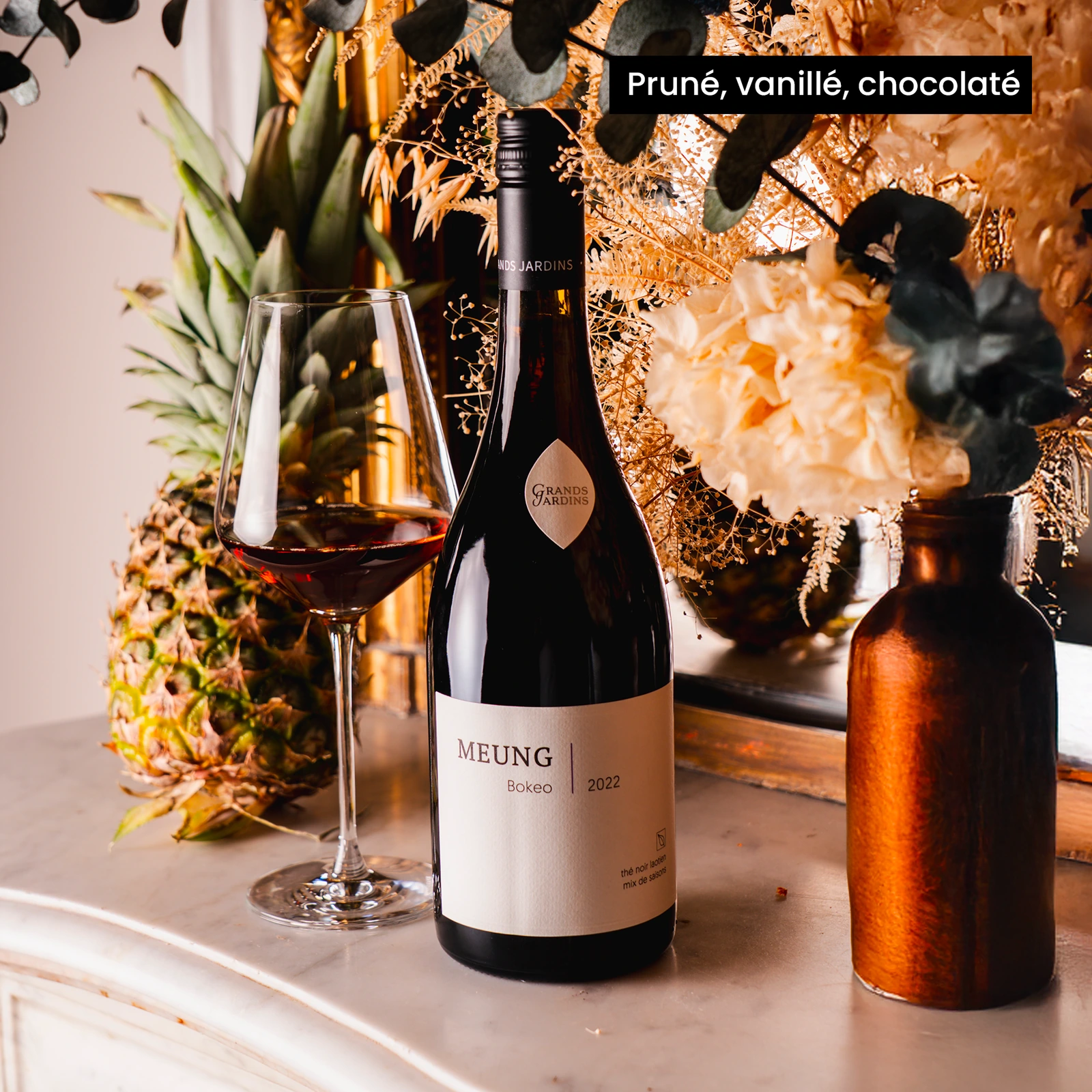
Tasting Profile
Appearance. Mahogany in colour, with dark highlights.[4]
Nose. Grands Jardins lists tasting notes of prune, vanilla and chocolate. A December 2025 account gives aromas of plum, vanilla and chocolate. A January 2026 feature describes notes of fresh tobacco, vanilla and baked apple.[2],[5]
Palate. The January 2026 feature describes a palate balanced by subtle hints of plum and chocolate, combined with mellow tannins, and an endless finish. A December 2023 article gives tasting notes of honey, tamarind, prune, cocoa, waxed wood and leather.[6]
Structure. Structural points stated in the sources:
- Tannin: mellow
- Length: endless finish
Pairings
A January 2026 feature pairs Meung with slow-cooked meat dishes. Luxury Touch suggests slow-cooked meats or dark chocolate desserts.[5]
Composition & Vinification
Provenance & Sourcing
Specifications. Laotian forest black tea from Bokeo. The product label declares the following nutritional values per 100 ml:[4]
- Energy: 1 kcal / 4 kJ
- Protein: 0.1 g
- Carbohydrates: 0.1 g (of which sugars 0.1 g)
- Salt, fat, saturated fatty acids: negligible
- Alcohol: none
- Theine: very low
Production. Meung is produced in France.[2]
Ingredients Policy. Grands Jardins states that Meung contains no sugar and no preservatives.[2]