 Green Tea
Green tea is a non-oxidized tea made from the leaves and buds of Camellia sinensis, halted from oxidizing by an early application of heat (steaming or pan-firing) so the leaf retains its green color and fresh character. Beyond loose-leaf brewing it appears in powdered, scented, blended, cold-bottled, and fermented forms.
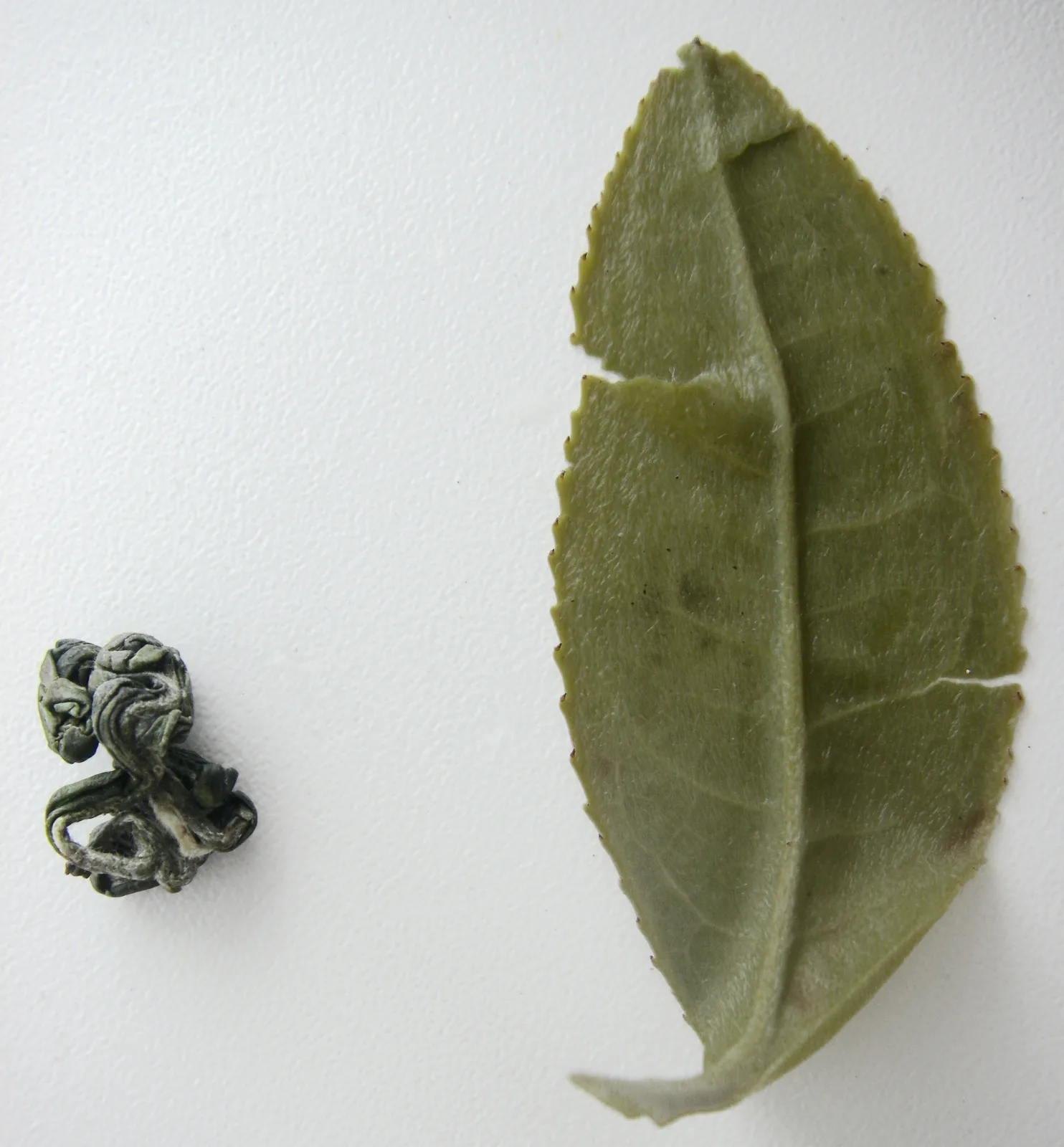
How green tea is prepared
Brewed hot as loose leaf or bagged tea; whisked as matcha; blended with rice, twigs, or flowers; sweetened with mint and sugar; served chilled and bottled; and used as the base for fermented drinks like kombucha.

Steeping an ingredient in cold or room-temperature water instead of hot water. Time and temperature depend on the documented application.
Grands Jardins makes its bottled teas by cold infusion (the producer calls it cold brewing). Time, temperature and dilution are not stated.[7]
Grands Jardins uses Cold-Infused Green Tea in Sakhejung, built from Green Tea.[8]
The producer combines hot and cold infusions. No sequence, temperature or duration is specified.[9]
Service signal Works as a liquid component.
Royal Blue Tea uses Cold-Infused Green Tea in King of Green GYOKURO THE YOSHIDA, built from Green Tea.[10][11]
Royal Blue Tea uses Cold-Infused Green Tea in King of Green GYOKURO THE YOSHIDA Elite, built from Green Tea.[11][12]
Royal Blue Tea uses Cold-Infused Green Tea in King of Green Higashi-Shirakawa, built from Green Tea.[10][11]
Royal Blue Tea uses Cold-Infused Green Tea in King of Green KIYOHARU, built from Green Tea.[11][13]
Royal Blue Tea uses Cold-Infused Green Tea in King of Green KIYOMI, built from Green Tea.[10][11]
Royal Blue Tea uses Cold-Infused Green Tea in King of Green KOICHIRO, built from Green Tea.[10][11]
Royal Blue Tea uses Cold-Infused Green Tea in King of Green RIICHI, built from Green Tea.[11][13]
Royal Blue Tea uses Cold-Infused Green Tea in King of Green TSUYOSHI The 14th, built from Green Tea.[11][14]
Three Spirit uses Cold-Infused Green Tea in Blurred Vines Spark, built from Green Tea.[15]

Steeping an ingredient in hot water. Temperature and duration depend on the documented application.
The producer combines hot and cold infusions. No sequence, temperature or duration is specified.[9]
Service signal Works as a liquid component.
Extracting an ingredient into a liquid or fat. Temperature and duration depend on the documented application.
NINO uses Sencha, Gunpowder, Lemon Verbena, Pai Mu Tan and Elderflower Infusion in Lily: a tea and herb infusion of Sencha and Gunpowder green teas, lemon verbena, Pai Mu Tan white tea and elderflower.[16]
Service signal Works as a infusion component.
Timo & Co uses Green Tea and Jasmine Infusion in Sparkling Maxim Jasmin: an infusion of green tea and jasmine.[17]
Service signal Works as a infusion component.

Fermentation with a SCOBY (symbiotic culture of bacteria and yeast) that contributes bright acidity.
Black and green tea kombucha is listed on the photographed label.[18]
Black and green teas are fermented into kombucha.[19]
Black and green tea kombucha is listed on the photographed label.[20]
BATU Kombucha uses Black and Green Tea Kombucha in Forest Fruits: a sweetened infusion of black and green teas fermented with a kombucha culture.[21][22]
BATU Kombucha uses Black and Green Tea Kombucha in Ginger & Lemon: a sweetened infusion of black and green teas fermented with a kombucha culture.[23]
BATU Kombucha uses Black and Green Tea Kombucha in Matcha & Yuzu: a sweetened infusion of black and green teas fermented with a kombucha culture.[24]
BATU Kombucha uses Black and Green Tea Kombucha in Passion Fruit & Mango: a sweetened infusion of black and green teas fermented with a kombucha culture.[25]
BATU Kombucha uses Black and Green Tea Kombucha in Vitamin Kombucha: a sweetened infusion of black and green teas fermented with a kombucha culture.[26][27]
BOUCHE uses Green Tea Kombucha in CHEEERRY Organic Kombucha: green tea fermented with a kombucha culture (SCOBY).[28]
BOUCHE uses Black and Green Tea Kombucha in HIBISKUS Pet Nat: a sweetened infusion of black and green teas fermented with a kombucha culture.[29]
BOUCHE uses Black and Green Tea Kombucha in HYBISKUS7 Organic Kombucha: a sweetened infusion of black and green teas fermented with a kombucha culture.[30]
BOUCHE uses Black and Green Tea Kombucha in LEMONDROP Organic Kombucha: a sweetened infusion of black and green teas fermented with a kombucha culture.[31]
Empress uses Black and Green Tea Kombucha in Beetroot Turmeric: a sweetened infusion of black and green teas fermented with a kombucha culture.[32]
Empress uses Black and Green Tea Kombucha in Brut: a sweetened infusion of black and green teas fermented with a kombucha culture.[33]
Empress uses Black and Green Tea Kombucha in Ginger Goji-berry: a sweetened infusion of black and green teas fermented with a kombucha culture.[32]
Empress uses Black and Green Tea Kombucha in Moonbrew: a sweetened infusion of black and green teas fermented with a kombucha culture.[34]
Empress uses Black and Green Tea Kombucha in Strawberry Hibiscus: a sweetened infusion of black and green teas fermented with a kombucha culture.[32]
Empress uses Black and Green Tea Kombucha in Venus Rose: a sweetened infusion of black and green teas fermented with a kombucha culture.[34][35]
EPICONE uses Kombucha Fermentation on Green Tea for Fermented Green Tea in AIR.[36]
EPICONE uses Kombucha Fermentation on Green Tea for Fermented Green Tea in FIRE.[36]
Kombucha Inc. uses Green Tea Kombucha in 2-2 MANGO: green tea fermented with a kombucha culture (SCOBY).[37]
Kombucha Inc. uses Green Tea Kombucha in AURORA: green tea fermented with a kombucha culture (SCOBY).[38]
Kombucha Inc. uses Green Tea Kombucha in PREMIUM: green tea fermented with a kombucha culture (SCOBY).[39]
Kombucha Inc. uses Green Tea Kombucha in THE STINGER: green tea fermented with a kombucha culture (SCOBY).[40]
Konanna uses Fermented Green Tea in Pétillant Naturel Tea Citronel, built from Green Tea.[41]
Konanna uses Green Tea Kombucha in Pétillant Naturel Tea Jasmine: green tea fermented with a kombucha culture (SCOBY).[42]
Listed as organic Yunnan green tea.[43]
Nivers uses Green Tea Kombucha in Nivers N°02 — Herbacée et Poudrée: green tea fermented with a kombucha culture (SCOBY).[44]
The base tea is Indian Nilgiri green tea made in the style of China's mao feng.[45][46]
Origin Nilgiri mountains, India
Service signal Works as a liquid component.
Copenhagen Sparkling Tea Company uses Roasted Green Tea Preparation in Sparkling Tea LYSEGRØN: green tea leaves heated by roasting to develop toasted aromatics.[47]
Service signal Works as a other component.
Other preparations
Acala uses Green Tea in White, built from Green Tea.[48]
AMA Brewery uses Green Tea in AMA No. 404 — Organic Ceylon Indulgashinna Rosé, built from Green Tea.[49]
AMA Brewery uses Green Tea in AMA No. 405 — Organic White Tips, built from Green Tea.[50]
Listed as steamed green tea.[51]
AMA Brewery uses Green Tea in AMA No. 540 — Organic Lemongrass, built from Green Tea.[52]
Copenhagen Sparkling Tea Company uses Green Tea in Sparkling Tea BLÅ, built from Green Tea.[53]
Yu Hua green tea, Spring 2023, Nanjing.[54]
Yu Hua green tea, Spring 2023, Nanjing.[55]
Listed as Japanese black and green teas with kombucha culture.[44]
Pettersson & Munthe uses Green Tea in Green Tea Rhubarb, built from Green Tea.[56]
Pettersson & Munthe uses Green Tea in Lavender Chai, built from Green Tea.[57]
Pettersson & Munthe uses Green Tea in Oolong Bergamot, built from Green Tea.[58][59]
Prima Radice uses Green Tea in Bruma, built from Green Tea.
Prima Radice uses Green Tea in Silva, built from Green Tea.
PROXIES uses Green Tea in Crisp White, built from Green Tea.[60][61]
Tempera uses Green Tea in AUBERA I, built from Green Tea.[62]
Tempera uses Green Tea in AUBERA II, built from Green Tea.[63]
Timo & Co uses Green Tea in Sparkling Oolong & Chamomile Timo & Co 0.75l, built from Green Tea.[64]
Single-origin.[65]
Origins
- Nilgiri mountains, India — 1 bottle: Nilgiri Green
62 bottles without a recorded origin.
In depth
Origins in China
Green tea traces its beginnings to China, where leaf tea was being drunk by the late first millennium BC and where, by legend, tea consumption began under the mythical emperor Shennong. Early Chinese green tea was steamed, but after the early Ming dynasty the prevailing method became pan-firing the leaves in a dry wok, a step that fixes the leaf's green color and grassy character before it can oxidize. Loose-leaf green tea has been the dominant form of tea in China since at least the Southern Song period, and the country still produces the largest share of the world's green tea. A wide range of regionally named styles are brewed simply by steeping the whole leaf in hot water, among them the pan-fired Dragon Well of Zhejiang, the snail-curled Green Snail Spring of Jiangsu, and the pellet-rolled Gunpowder tea. Quality teas are typically infused cooler and for shorter times, often across several short steepings, to draw out flavor without excessive bitterness.[1]
Powdered tea and the path to matcha
A distinct way of drinking green tea emerged in China during the Tang and especially the Song dynasties, when steamed and dried leaves were milled to a fine powder and whisked with hot water into a frothy drink. Japanese Zen monks visiting Chinese temples encountered this whisked powdered tea, and the monk Eisai is credited with carrying the practice back to Japan around the turn of the thirteenth century, along with tea seeds and a tract praising tea's health value. While powdered tea faded in China after the Ming emperor banned compressed tea in the late fourteenth century, it took deep root in Japan. There it evolved into matcha: shade-grown leaves are steamed and dried without rolling to make tencha, which is then stone-ground into a bright green powder. Whisked in a bowl until foamy, matcha became the centerpiece of the Japanese tea ceremony, prized for its vivid color and rich umami, and is also used to flavor lattes, sweets, and confections.[2]
Japanese leaf teas: sencha and gyokuro
Most Japanese green tea is consumed not as powder but as infused leaf tea, and the defining processing difference from Chinese tea is that the leaves are steamed rather than pan-fired soon after picking. Steaming halts oxidation, yields a cloudy, deeply colored liquid, and gives Japanese green tea its characteristic sweet, vegetal, sometimes seaweed-like flavor. Sencha, made from leaves grown in full sun, is by far the most popular type and accounts for the great majority of tea produced in the country; its taste shifts with water temperature, becoming mellower when brewed cool and more astringent when brewed hot, while the prized first-flush shincha is celebrated for its fresh aroma. Gyokuro is made in a similar way but from plants shaded for roughly three weeks before harvest, a technique that raises the amino acid theanine and lowers astringency to produce a sweeter, intensely umami cup. It is among the most expensive Japanese teas and is brewed gently with low-temperature water and a high leaf-to-water ratio.[3]
Roasted and blended Japanese styles
Japanese tea culture also produced everyday styles built by blending or roasting the leaf. Genmaicha combines green tea with roasted, popped brown rice, lending a warm, nutty taste to a light-yellow infusion; once an economical 'people's tea' that stretched the leaf, it is now enjoyed across society and is sometimes enriched with a little matcha powder. Hojicha takes a different route, roasting bancha or kukicha over high heat until the leaves turn reddish-brown; the process, said to have been discovered by accident in Kyoto in the 1920s, strips out much of the bitterness and caffeine and yields a toasty, almost caramel-like, low-astringency drink often served in the evening or to children and the elderly. Both styles show how green tea was diversified into mild, comforting beverages suited to daily drinking rather than ceremony.[4]
Korea and Vietnam
On the Korean peninsula, green tea arrived with Buddhism around the fourth century and flourished as a temple and court drink, offered to the Buddha and to ancestral spirits, with tea rites that gave their name to later ancestral ceremonies. After centuries of decline under suppression and war, Korean green tea was revived from the 1970s, and southern regions such as Boseong, Hadong, and Jeju now produce well-regarded leaf. Korean teas are classified chiefly by harvest time, from the delicate pre-rain ujeon through sejak and jungjak to the late daejak, and are mostly pan-roasted, though steamed temple-style teas also exist; green tea is also blended with roasted brown rice or with lemon. In Vietnam, green tea is the most widely drunk tea, supported by an ancient drinking culture and large-scale cultivation introduced under French colonial rule, with the Thai Nguyen area regarded as its heartland. Vietnamese green tea is often scented with flowers, producing lotus tea, jasmine tea, and chrysanthemum tea among others.[1]
Maghrebi mint tea
Outside East Asia, green tea anchors one of North Africa's most distinctive drinks. Maghrebi mint tea is made from gunpowder green tea brewed with fresh spearmint and generous sugar, using boiling water rather than the cooler water favored in East Asia. Gunpowder tea reached the region through European, especially British, trade in the eighteenth and nineteenth centuries, and the custom of infusing green tea with mint spread from Morocco across Algeria, Tunisia, Libya, and into the Sahara, where it is especially cherished among the Tuareg. The preparation is bound up with hospitality and social life: the tea is typically served in at least three glasses, each steeped longer and tasting different from the last, and is poured from a height to aerate it and settle the leaves. In colder months or when mint is scarce, herbs such as wormwood, lemon verbena, sage, or thyme are added.[5]
Fermented and modern global drinks
In the present day green tea reaches drinkers in an ever wider range of forms. It serves as a base for kombucha, a fermented, lightly effervescent and sweetened tea made by adding a symbiotic culture of bacteria and yeast to sugared tea; believed to have originated in China and later popularized in Russia, Europe, and eventually the West, kombucha is now brewed at home and bottled commercially, usually with under half a percent alcohol. Beyond fermentation, green tea is widely sold chilled and bottled, often unsweetened in Japan and sweetened elsewhere, and matcha in particular has surged into global cafe culture as a vivid green latte, iced drink, and smoothie ingredient, its popularity amplified by social media and so strong that it has strained traditional Japanese supply. From simple loose-leaf steeping to whisked powder, scented blends, sweet mint preparations, and fermented and cold drinks, green tea remains one of the most versatile foundations in the no- and low-alcohol beverage world.[6]
Styles


Part of Camellia Sinensis
References
- [1]EncyclopediaGreen tea — Wikipedia↑§1↑§5
- [2]EncyclopediaMatcha — Wikipedia↑§2
- [3]EncyclopediaSencha — Wikipedia↑§3
- [4]EncyclopediaGenmaicha — Wikipedia↑§4
- [5]EncyclopediaMaghrebi mint tea — Wikipedia↑§6
- [6]EncyclopediaKombucha — Wikipedia↑§7
- [7]Product informationGingembré N°1 — retained official source (captured 2026-11-09; publication date unknown)↑prepared
- [8]Producerhttps://www.grands-jardins.com/boutique/p/sakhejung↑prepared
- [9]ProducerThea Placida Guizhou Floral (laoinc.ca)↑prepared
- [10]Produceronline.royalbluetea.com↑prepared
- [11]Instagram@royalbluetea.japan — Oct 28, 2019↑prepared
- [12]Produceronline.royalbluetea.com↑prepared
- [13]Produceronline.royalbluetea.com↑prepared
- [14]Produceronline.royalbluetea.com↑prepared
- [15]ProducerThe Bestsellers (threespiritdrinks.com)↑prepared
- [16]ProducerNino Discovery Set 1 (ninodrinks.com)↑prepared
- [17]Product informationSparkling Green Tea & Jasmine Timo & Co – Florian Fine Wine Shop↑prepared
- [18]Product informationAKA Fig Leaves — photographed bottle label↑prepared
- [19]Product informationAka - Kombucha Genmaicha - Analcolico↑prepared
- [20]Product informationAKA Jasmine — photographed bottle label↑prepared
- [21]Producerhttps://www.batukombucha.com/en/products/forest-fruits/↑prepared
- [22]ProducerBatu Kombucha Forest Fruits (batukombucha.com)↑prepared
- [23]Producerhttps://www.batukombucha.com/en/products/ginger-lemon/↑prepared
- [24]Producerhttps://www.batukombucha.com/en/products/matcha-yuzu/↑prepared
- [25]Producerhttps://www.batukombucha.com/en/products/passion-fruit-mango/↑prepared
- [26]ProducerHard Kombucha (batukombucha.com)↑prepared
- [27]ProducerWhat Is Kombucha (batukombucha.com)↑prepared
- [28]Product informationBOUCHE — CHEEERRY Organic Kombucha (24 × 0.33 L) ingredient excerpt (retained 2026-11-09)↑prepared
- [29]Producerhttps://www.drinkbouche.com/en/products/hibiskuspetnat?pr_prod_strat=jac&pr_rec_id=e74f5ee21&pr_rec_pid=6692365172872&pr_ref_pid=5254039634056&pr_seq=uniform↑prepared
- [30]Product informationBOUCHE — HYBISKUS7 Organic Kombucha (24 × 0.33 L) ingredient excerpt (retained 2026-11-09)↑prepared
- [31]Product informationBOUCHE — LEMONDROP Organic Kombucha (24 × 0.33 L) ingredient excerpt (retained 2026-11-09)↑prepared
- [32]ProducerKombucha (empress.no)↑prepared
- [33]Product informationEmpress Brut - Vinmonopolet↑prepared
- [34]ProducerWinealts (empress.no)↑prepared
- [35]Product informationVenus Rose - 330 ml - Oda↑prepared
- [36]Producerepicone.life↑prepared
- [37]Producer2 2 Mango 1 (kombuchainc.com)↑prepared
- [38]ProducerAurora (kombuchainc.com)↑prepared
- [39]ProducerPremium 1 (kombuchainc.com)↑prepared
- [40]ProducerThe Stinger 1 (kombuchainc.com)↑prepared
- [41]ProducerKonanna Low Alc (konanna.at)↑prepared
- [42]ProducerKonanna Alk (konanna.at)↑prepared
- [43]ProducerPetillant Naturel Tea Yunnan (konanna.at)↑prepared
- [44]ProducerPack 3 Cuvées Nivers (nivers.fr)↑prepared
- [45]ProducerNG PRODUCT PAGE (unifiedferments.com)↑prepared
- [46]ProducerEXPERIMENT (unifiedferments.com)↑prepared
- [47]ProducerSparkling Tea Lysegron (sparklingtea.co)↑prepared
- [48]Producerdrinkacala.com↑prepared
- [49]Product informationAMA® NO. 404 - CEYLON INDULGASHINNA ROSÉ — AMA Petnat↑prepared
- [50]Product informationAMA® NO. 405 - WHITE TIPS TEA – Ama Brewery↑prepared
- [51]Product informationAMA Brewery official product page, retained 2026-11-09 — ama-brewery-no-4-golden-lily↑prepared
- [52]Product informationAMA Brewery official product page, retained 2026-11-09 — ama-brewery-no-540-lemongrass↑prepared
- [53]ProducerAge Verification - Sparkling Tea↑prepared
- [54]ProducerGuan 2025 (mindful-sparks.com)↑prepared
- [55]ProducerZing 2025 (mindful-sparks.com)↑prepared
- [56]Product informationGreen Tea Rhubarb - Pettersson & Munthe Non alcoholic Sparkling Tea↑prepared
- [57]Producerhttps://petterssonmunthe.com/products/winter-sparkling-tea/↑prepared
- [58]Product informationPettersson & Munthe - BERGAMOT OOLONG - 750 ML - 0 - $21.95 - Le Cellier↑prepared
- [59]Producerhttps://petterssonmunthe.com/products/non-alcoholic-sparkling-tea/↑prepared
- [60]ProducerBuild A Box 2 (drinkproxies.com)↑prepared
- [61]Product informationCrisp White – Proxies↑prepared
- [62]Product informationTempera — AUBERA I (formerly ETERNA I) ingredient excerpt (retained 2026-11-09)↑prepared
- [63]Product informationTempera — AUBERA II (formerly ETERNA II) ingredient excerpt (retained 2026-11-09)↑prepared
- [64]Product informationSparkling Oolong & Chamomile Timo & Co – Florian Fine Wine Shop↑prepared
- [65]Instagram@yesfolk — Oct 29, 2025↑prepared