 Camellia Sinensis
Also known as: tea plant, tea
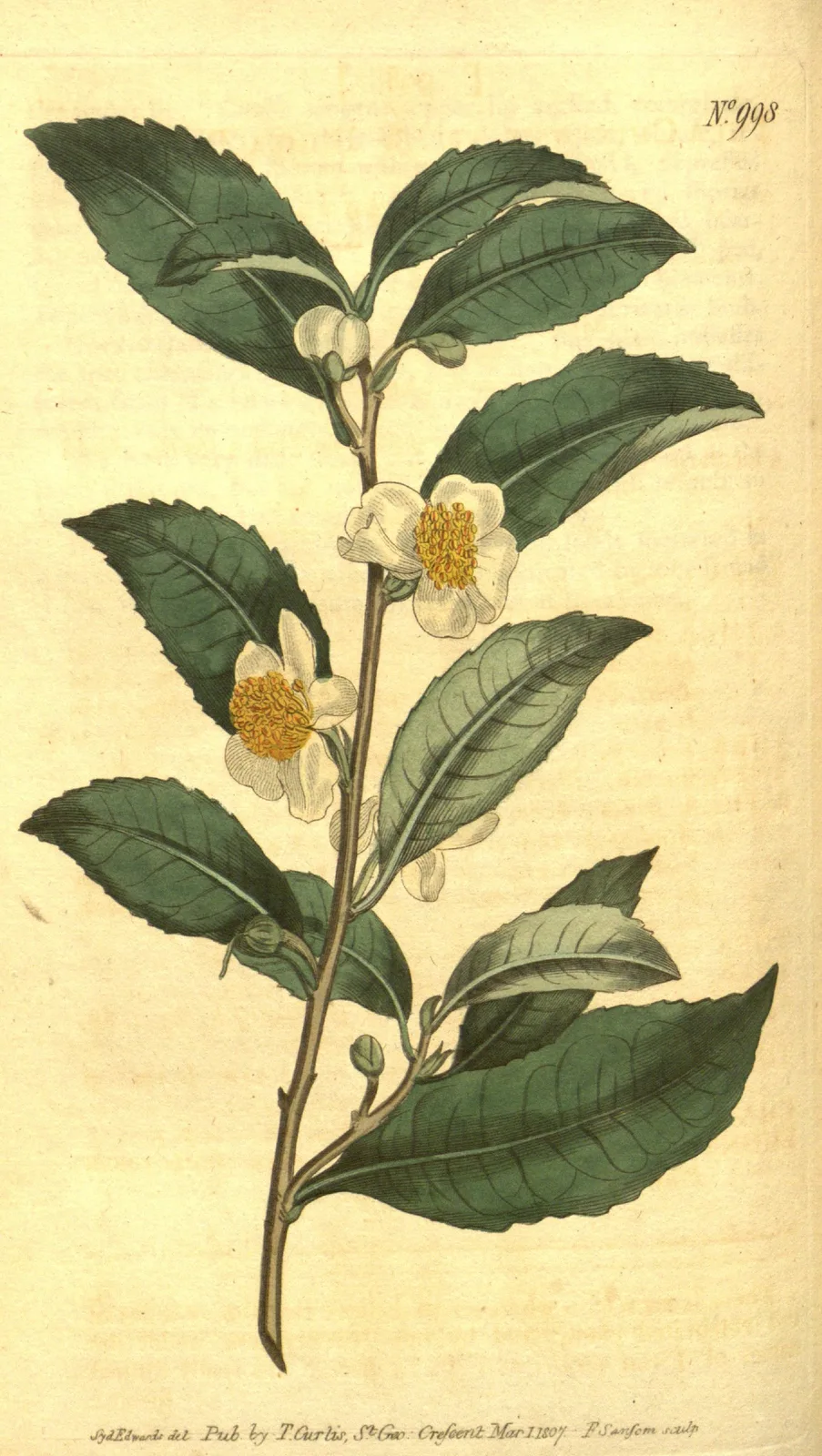
Camellia sinensis is the evergreen shrub or small tree whose leaves, buds, and stems furnish all true tea. Differences in withering, oxidation, firing, and microbial fermentation yield the major styles — white, green, yellow, oolong, black, and dark (fermented) teas — making a single plant the source of one of the world's most widely consumed brewed and infused beverages.
How camellia sinensis is prepared
Used primarily as a hot or iced infusion of dried leaves, but also as a base for spiced milk teas, churned salted tea, blended and scented teas, and as the sugared substrate fermented into kombucha. Compressed tea bricks once even served as currency along trade routes.

Fermentation with a SCOBY (symbiotic culture of bacteria and yeast) that contributes bright acidity.
Ambijus uses Kombucha-Fermented Tea in Act Naturally, built from Camellia Sinensis.[8]
Ambijus uses Kombucha-Fermented Tea in Real Fantasy, built from Camellia Sinensis.[8]
ARENSBAK uses Kombucha-Fermented Tea in ARENSBAK Effervescent, built from Camellia Sinensis.[9]
ARENSBAK uses Kombucha-Fermented Tea in ARENSBAK Red, built from Camellia Sinensis.[9]
ARENSBAK uses Kombucha-Fermented Tea in ARENSBAK Rosé, built from Camellia Sinensis.[9]
ARENSBAK uses Kombucha-Fermented Tea in ARENSBAK White, built from Camellia Sinensis.[9]
BOUCHE uses Kombucha-Fermented Tea in CHEEERRY Organic Kombucha, built from Camellia Sinensis.[10]
BOUCHE uses Kombucha-Fermented Tea in EARLYBIRD Organic Kombucha, built from Camellia Sinensis.[11][12]
BOUCHE uses Kombucha-Fermented Tea in HIBISKUS Pet Nat, built from Camellia Sinensis.[13]
BOUCHE uses Kombucha-Fermented Tea in HYBISKUS7 Organic Kombucha, built from Camellia Sinensis.[10]
BOUCHE uses Kombucha-Fermented Tea in JUNIPER Pet Nat, built from Camellia Sinensis.[14]
BOUCHE uses Kombucha-Fermented Tea in LEMONDROP Organic Kombucha, built from Camellia Sinensis.[10]
BOUCHE uses Kombucha-Fermented Tea in MELONE SZECHUAN Pet Nat, built from Camellia Sinensis.[15]
København Kombucha uses Kombucha-Fermented Tea in Bee Pollen, built from Camellia Sinensis.[16]
København Kombucha uses Kombucha-Fermented Tea in Brew & Bloom, built from Camellia Sinensis.[17][18]
København Kombucha uses Kombucha-Fermented Tea in Cherry Blossom, built from Camellia Sinensis.[19]
København Kombucha uses Kombucha-Fermented Tea in Hidcote Blue, built from Camellia Sinensis.[16]
København Kombucha uses Kombucha-Fermented Tea in Nordic Grove, built from Camellia Sinensis.[20]
København Kombucha uses Kombucha-Fermented Tea in Rosa Rugosa, built from Camellia Sinensis.[21]
København Kombucha uses Kombucha-Fermented Tea in Silent Shore, built from Camellia Sinensis.[22][23]
København Kombucha uses Kombucha-Fermented Tea in Summer Haze, built from Camellia Sinensis.[24][25]
Kombucha Inc. uses Kombucha-Fermented Tea in 2-2 MANGO, built from Camellia Sinensis.[26]
Kombucha Inc. uses Kombucha-Fermented Tea in AURORA, built from Camellia Sinensis.[27]
Kombucha Inc. uses Kombucha-Fermented Tea in PREMIUM, built from Camellia Sinensis.[28]
Kombucha Inc. uses Kombucha-Fermented Tea in THE STINGER, built from Camellia Sinensis.[29]
Leave Your Sword uses Kombucha-Fermented Tea in Ceylon OP – Neluwa Garden, built from Camellia Sinensis.[30]
Leave Your Sword uses Kombucha-Fermented Tea in Darjeeling Black First Flush FTGFOP1 Soom Garden, built from Camellia Sinensis.[31]
Leave Your Sword uses Kombucha-Fermented Tea in Earl Grey, built from Camellia Sinensis.[32]
Leave Your Sword uses Kombucha-Fermented Tea in Elderflower, built from Camellia Sinensis.[33]
Leave Your Sword uses Kombucha-Fermented Tea in Green Jasmine, built from Camellia Sinensis.[34]
Leave Your Sword uses Kombucha-Fermented Tea in Lapsang Souchong, built from Camellia Sinensis.[35]
Leave Your Sword uses Kombucha-Fermented Tea in Meadowsweet & Green Sencha, built from Camellia Sinensis.[36]
Leave Your Sword uses Kombucha-Fermented Tea in Milky Oolong Semi-oxidised Spring harvest, built from Camellia Sinensis.[37]
Leave Your Sword uses Kombucha-Fermented Tea in Verbena & Green Sencha, built from Camellia Sinensis.[38]
Nivers uses Kombucha-Fermented Tea in Nivers N°02 — Herbacée et Poudrée, built from Camellia Sinensis.[39][40]
Nivers uses Kombucha-Fermented Tea in Nivers N°05 — Florale et Hespéridée, built from Camellia Sinensis.[41][42]
Other preparations
Acala uses Fermented Tea in Red: tea transformed by a controlled fermentation step.[43]
Service signal Works as a liquid component.
Acala uses Fermented Tea in Rosé: tea transformed by a controlled fermentation step.[43]
Service signal Works as a liquid component.
Acala uses Fermented Tea in White: tea transformed by a controlled fermentation step.[43]
Service signal Works as a liquid component.
Konanna uses Fermented Tea in Pétillant Naturel Tea Jasmine: tea transformed by a controlled fermentation step.[44]
Service signal Works as a liquid component.
Konanna uses Fermented Tea in Pétillant Naturel Tea Yunnan: tea transformed by a controlled fermentation step.[45]
Service signal Works as a liquid component.
REAL uses Fermented Tea in Blush: tea transformed by a controlled fermentation step.[46]
Service signal Works as a liquid component.
REAL uses Fermented Tea in Dry: tea transformed by a controlled fermentation step.[46]
Service signal Works as a liquid component.
REAL uses Fermented Tea in Sec: tea transformed by a controlled fermentation step.[46]
Service signal Works as a liquid component.
Menghai Sheng Tai pu-erh from Xishuangbanna, prepared with combined hot and cold infusions. No sequence, brewing temperature or duration is specified. Use published true tea as the broad ingredient; the precise identity remains in the preparation name and claims.[47]
Service signal Works as a liquid component.
In depth
Origins in East Asia
Tea as a drink traces back to East Asia, where Camellia sinensis was first gathered and cultivated for its leaves. Although the plant's exact wild origin is debated, the species is generally placed in southern China and the surrounding borderlands stretching toward Indo-Burma and Tibet. Two varieties came to dominate cultivation: the small-leaved Chinese plant and the large-leaved Assam plant, which diverged from one another tens of thousands of years ago. Every classic style of tea — white, green, yellow, oolong, black, and fermented dark tea — is produced from these plants, the differences arising not from separate species but from how the harvested leaf is withered, oxidized, fired, or microbially fermented. Because the dried leaf retains its character over time, especially in its more oxidized forms, tea became an early article of long-distance trade, with pressed bricks of dark tea even circulating as a form of currency in Mongolia, Tibet, and Siberia into the 19th century.[1]
Green tea and Chinese tea culture
Green tea, made from leaves that are kept from oxidizing, is the oldest widely consumed style and is traditionally associated with China, where it emerged in the late first millennium BC. Its production later spread across East Asia. Loose-leaf green tea became the dominant form of tea in China by the Southern Song period, and after the early Ming dynasty Chinese green teas were typically pan-fired in a dry wok rather than steamed, a step that shaped their characteristic flavor. The craft of brewing matters as much as the leaf: lower water temperatures and shorter steeps preserve a sweeter, less bitter cup, while higher-grade leaves are often infused several times. Green tea remains the most widely produced form of tea in China and anchors a tea culture built around careful steeping, small cups, and repeated infusion.[2]
Oolong and the gongfu tradition
Oolong is a partially oxidized tea, sitting between green and black in both processing and character. It is made by withering the leaves under strong sun and allowing controlled oxidation — anywhere from lightly to heavily oxidized — before the leaves are curled, twisted, and fired. The style is especially tied to southeastern China, above all the Wuyi Mountains and Anxi County in Fujian, and to Taiwan, where high-mountain cultivation produces prized sweet, aromatic teas. Oolongs span a remarkable flavor range, from green and floral to woody and roasted, with famous examples such as Wuyi cliff teas and Tieguanyin. The leaf is closely linked to the Fujian gongfu method of preparation, in which a small vessel like a gaiwan or Yixing clay pot is filled with a generous quantity of leaf and steeped many times in short successive infusions to draw out evolving flavors.[3]
Black tea and its spread westward
Black tea, called 'red tea' in Chinese for the color of its brewed liquor, is the most oxidized of the leaf styles and the most robust in flavor. It originated in China but became the tea most associated with consumption across Europe and the wider world. Because it keeps its flavor for years rather than months, it traveled well and lent itself to large-scale trade. In the 1830s, anxious about Chinese dominance of the tea supply, British interests began cultivating the native Assam plant in India, and over the following decades Indian and Ceylon teas displaced Chinese leaf in British cups. Unblended black teas are often named for their region — Assam, Darjeeling, Keemun, Ceylon, and others — each with a recognizable profile. Black tea also became the foundation of countless blends and flavored teas, the best known being a bergamot-scented style of black tea, along with breakfast blends combining Assam, Ceylon, and other leaves.[4]
Himalayan butter tea
In the Himalayan and Central Asian highlands, Camellia sinensis is consumed in a form far removed from a delicate infusion. Butter tea, known in Tibetan as po cha or churned tea, is made by boiling tea — often pu'er or another dark brick tea — for a long time into a strong dark decoction, then churning it with butter, traditionally from the yak, and salt until it reaches the consistency of a thick, oily broth. Tea reached Tibet by the 7th century along trade routes from China, and the buttered, salted preparation became widespread by about the 13th century. Rich in calories and well suited to cold, high-altitude life, butter tea is a staple of daily hospitality and ceremony across Tibet, Bhutan, Nepal, Ladakh, and neighboring regions, where guests' bowls are continually topped up and the drink features at births, funerals, and New Year observances.[5]
Masala chai of the Indian subcontinent
On the Indian subcontinent, tea found one of its most distinctive expressions in masala chai — black tea brewed together with milk, water, sugar, and aromatic spices. Although tea plants grew wild in Assam, Indians long regarded the leaf as a medicine rather than a daily drink, and large-scale black tea drinking took hold only after British cultivation and an early 20th-century promotional campaign that encouraged tea breaks and supported railway-side vendors. Independent chaiwalas added spices and increased the milk and sugar, and the spiced, milky style became firmly established. Typically built on crush-tear-curl Assam or blended black tea and flavored with cardamom, ginger, cinnamon, cloves, and other spices, chai is sold from countless roadside stalls and has made India one of the world's largest tea-consuming nations. The drink has since spread internationally, appearing in coffeehouses worldwide as a spiced latte-style beverage.[6]
Kombucha and the fermented-tea revival
In the present day, Camellia sinensis also underpins kombucha, a fermented, lightly effervescent, sweetened tea drink. It is made by steeping tea — typically black tea — in sugared water and fermenting it with a symbiotic culture of bacteria and yeast, often called a 'mother' or SCOBY, which converts sugars into acids and a small amount of alcohol, giving the drink its tart, fizzy character and usually keeping it below half a percent alcohol when commercially bottled. Believed to have originated in China, where it was once used regionally as a folk remedy, kombucha spread to Russia and then into Eastern and Central Europe by the 19th and early 20th centuries, and surged in popularity in the West in the early 21st century. Now homebrewed and bottled around the globe and frequently flavored with fruit, juice, or spices, it has grown into a substantial commercial category and is often marketed as a low-alcohol alternative to beer, even spawning higher-alcohol 'hard' versions.[7]
Cultivars
Processing Categories


Related

References
- [1]EncyclopediaCamellia sinensis — Wikipedia↑§1
- [2]EncyclopediaGreen tea — Wikipedia↑§2
- [3]EncyclopediaOolong — Wikipedia↑§3
- [4]EncyclopediaBlack tea — Wikipedia↑§4
- [5]EncyclopediaButter tea — Wikipedia↑§5
- [6]EncyclopediaMasala chai — Wikipedia↑§6
- [7]EncyclopediaKombucha — Wikipedia↑§7
- [8]ProducerHome (ambijus.com)↑prepared↑prepared
- [9]Producerhttps://www.arensbak.com/↑prepared↑prepared↑prepared↑prepared↑prepared
- [10]ProducerKombucha Bio (drinkbouche.com)↑prepared↑prepared↑prepared
- [11]Producerdrinkbouche.com↑prepared
- [12]Producerhttps://www.drinkbouche.com/en/blogs/news/kombucha-during-pregnancy-what-you-should-know↑prepared
- [13]ProducerHibiskuspetnat (drinkbouche.com)↑prepared
- [14]ProducerJuniper Pet Nat 0 75 (drinkbouche.com)↑prepared
- [15]Producerhttps://www.drinkbouche.com/products/melonpetnat↑prepared
- [16]ProducerDa (kobenhavnkombucha.com)↑prepared↑prepared
- [17]ProducerBrewbloom 75cl E (kobenhavnkombucha.com)↑prepared
- [18]FeatureFrom First Brew to 0.0%: The Story of København Kombucha — Dansk Sommelier Forening↑prepared
- [19]ProducerIngredientsingredientsen Water Sugar Tea Cherry Flower Hibiscus Co2 Kombucha Culture Dk Vand Sugarte Kirsebærblomst Hibiskus Co2 Kombucha Kultur De Wasser Tee Kirschblüten Hibiskus Co2 Kombucha Kultur (kobenhavnkombucha.com)↑prepared
- [20]ProducerNordicgrove 75cl E (kobenhavnkombucha.com)↑prepared↑prepared
- [21]Producerblog↑prepared
- [22]ProducerSilentshore 75cl E (kobenhavnkombucha.com)↑prepared
- [23]ProducerSilentshore 75cl E (kobenhavnkombucha.com)↑prepared
- [24]ProducerSommerhaze 75cl E (kobenhavnkombucha.com)↑prepared
- [25]ProducerSommerhaze 75cl E (kobenhavnkombucha.com)↑prepared
- [26]Producer2 2 Mango 1 (kombuchainc.com)↑prepared
- [27]ProducerAurora (kombuchainc.com)↑prepared
- [28]Producerhttps://kombuchainc.com/products/premium-1↑prepared
- [29]ProducerThe Stinger 1 (kombuchainc.com)↑prepared
- [30]ProducerCeylon Op Neluwa (leaveyoursword.com)↑prepared
- [31]ProducerDarjeeling Black First Flush (leaveyoursword.com)↑prepared
- [32]ProducerEarl Grey (leaveyoursword.com)↑prepared
- [33]ProducerElderflower (leaveyoursword.com)↑prepared
- [34]ProducerGreen Jasmine (leaveyoursword.com)↑prepared
- [35]ProducerLapsang Souchong (leaveyoursword.com)↑prepared
- [36]ProducerMeadowsweet And Green Sencha (leaveyoursword.com)↑prepared
- [37]ProducerMilky Oolong Semi Oxidised Spring Harvest (leaveyoursword.com)↑prepared
- [38]ProducerVerbena And Green Sencha (leaveyoursword.com)↑prepared
- [39]ProducerPack 3 Cuvées Nivers (nivers.fr)↑prepared↑prepared
- [40]Producernivers.fr↑prepared
- [41]ProducerPack 3 Cuvées Nivers (nivers.fr)↑prepared↑prepared
- [42]Producerhttps://www.nivers.fr/en/product-page/nivers-n-05-florale-et-hesp%C3%A9rid%C3%A9e-1↑prepared
- [43]Producerhttps://drinkacala.com/↑prepared↑prepared↑prepared↑prepared
- [44]Producerhttps://konanna.at/products/konanna-alk↑prepared
- [45]Producerhttps://konanna.at/products/petillant-naturel-tea-yunnan↑prepared
- [46]Producerhttps://realalcoholfree.com/collections/alcohol-free↑prepared↑prepared↑prepared
- [47]ProducerThea Placida Yunnan Bold (laoinc.ca)↑prepared↑prepared